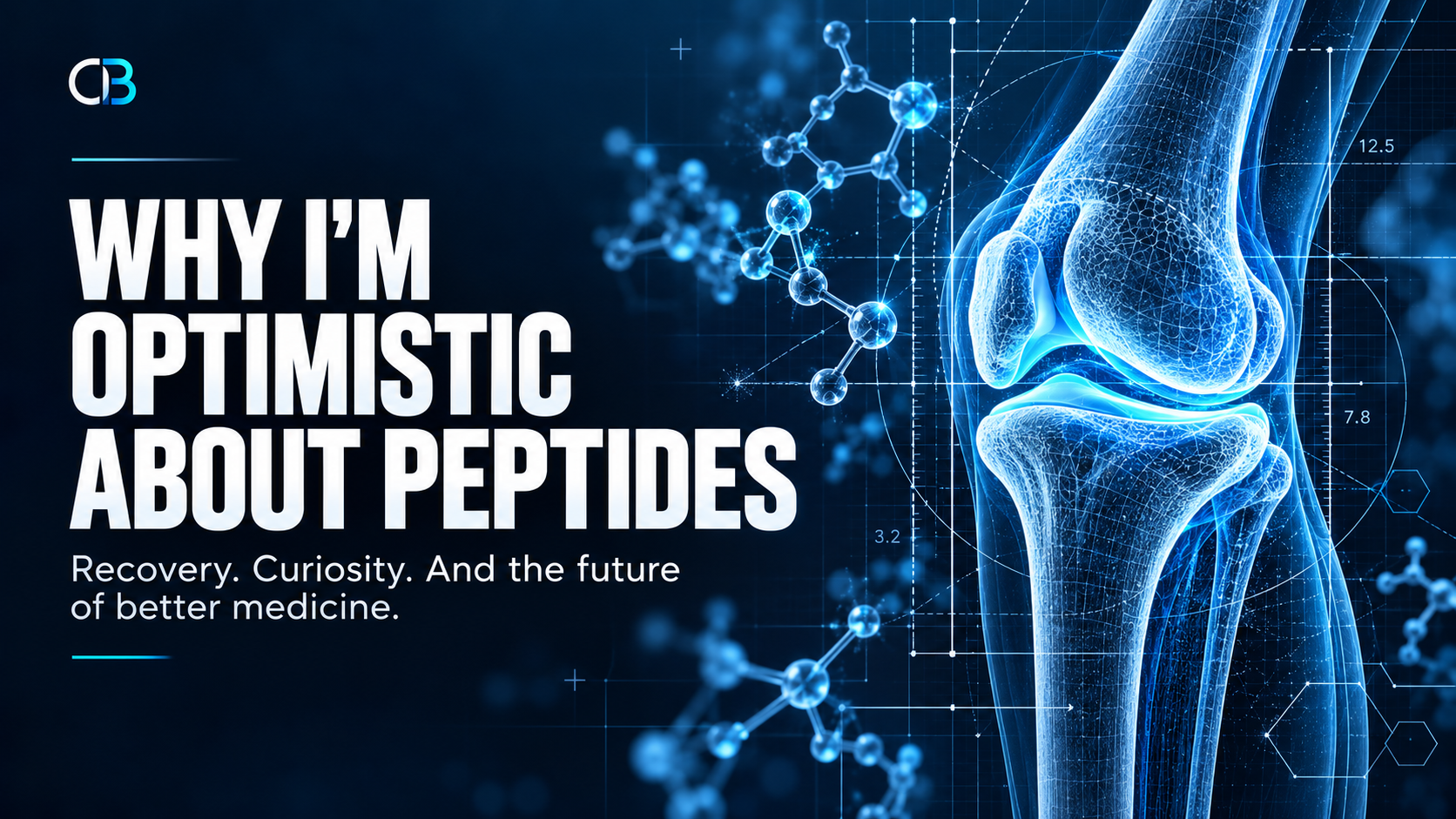
My experience with injuries, recovery, and experimental compounds has made me believe we're only scratching the surface of what's possible.
I've spent a lot of time thinking about recovery.
Not just recovering from a difficult workout, but recovering from injuries that change what you're physically capable of doing. The kind that require surgery, months of rehabilitation, and an uncomfortable amount of patience.
As a former college athlete, I've experienced how frustrating the recovery process can be. You can do everything you're supposed to do, follow your rehabilitation program, rebuild strength, and still find yourself dealing with setbacks.
That experience changed how I think about the human body.
And somewhere along the way, I became fascinated with peptides.
Many experimental peptides have been studied for years, sometimes with fascinating results in animals. Yet relatively few have progressed into well-designed human trials.
Why?
Drug development is expensive. Financial incentive and patentability are not always applicable to peptides since they are biological molecules. That doesn't explain every peptide's lack of human research, but I believe some potentially interesting discoveries deserve closer investigation.
That's one of the reasons I'm optimistic about peptides.
Not because I believe every peptide being promoted online works. Not because I think they're going to eliminate injuries, stop aging, or replace traditional medicine.
I'm optimistic because the underlying science is interesting, and in certain areas, it's already producing meaningful results.
So, How Am I Finding Out What I Believe?
I'm not just reading about peptides.
I've decided to explore some of them personally, while understanding that self-experimentation with unapproved compounds carries risks and cannot establish their safety or effectiveness.
I'm taking notes, paying attention to how I feel, and documenting my experiences over time.
Some of the compounds I've experimented with include BPC-157, TB-500, Selank, Semax, Cartalax, GLOW, and retatrutide.
With some of them, I'm interested in observing changes over longer periods. With others, I've noticed subjective effects much sooner.
Three have particularly stood out to me.
Selank and Semax: In my personal experience, both have been associated with noticeable improvements in focus and a calm, peaceful feeling throughout the day.
Retatrutide: This is another compound where I've personally noticed effects. My experience has made me understand why there's so much interest in its clinical development.
That doesn't mean I can prove these compounds caused every change I've noticed. It also doesn't mean someone else will experience the same results.
These are personal observations, not clinical conclusions or recommendations for others to experiment.
I'm particularly excited about BPC-157 and TB-500, as community notes are extraordinary. I will for sure relay my findings in about 1.5 months.
Here is the lab I trust: Endure Biolabs
But I think documenting both the positive and negative experiences matters.
I'm interested in what works, what doesn't, what changes over time, and what the research eventually confirms.
I don't want to pretend I have all the answers.
I'm trying to ask better questions and learn along the way.
The Science Is Promising, but We Still Have a Lot to Learn
Peptides are short chains of amino acids that can act as messengers in the body, influencing everything from appetite and metabolism to growth and cellular communication.
They're not new. Insulin has been used for over a century, and medications such as semaglutide and tirzepatide have demonstrated just how powerful targeting specific biological signals can be.
Other peptides, such as BPC-157, TB-500, MOTS-c, and GHK-Cu, have attracted interest for their potential roles in tissue repair, inflammation, and cellular health.
But here's the distinction: promising animal research doesn't automatically translate into successful human treatments.
Many of these compounds still lack strong human clinical evidence. Some may eventually prove useful, while others may never deliver the benefits people expect.
I'm excited about what we might discover, not pretending we already have all the answers.
Recovery Medicine Still Has a Long Way to Go
This is where my interest becomes personal.
We've made incredible advances in surgery, rehabilitation, and sports medicine. But when you're the person dealing with a serious injury, you realize just how much remains outside our control.
A repaired ligament doesn't immediately regain its original strength.
A tendon can remain painful for months.
And sometimes, even when doctors tell you everything looks good, your body tells you otherwise.
I've experienced that frustration firsthand.
The uncertainty. The setbacks. The endless rehabilitation sessions. The feeling that you're making progress, only to find yourself starting over again.
I don't believe a peptide is going to magically fix those problems.
But I do believe there's enormous potential in better understanding the biological processes involved in healing.
What if future treatments could help certain tissues recover more effectively? What if we could improve rehabilitation outcomes or reduce the long-term consequences of some injuries?
We aren't there yet for many of the experimental compounds being discussed today.
But even modest improvements could make an enormous difference for people dealing with serious injuries.
For someone who's spent years trying to get back to doing what they love, that's a future worth investigating.
I'm Optimistic About Peptide Research, Not the Hype
There's something about the peptide community that both excites and frustrates me.
On one side, you have people genuinely interested in emerging science, asking questions, sharing research, and exploring possibilities that traditional medicine hasn't fully investigated.
On the other, you have people selling experimental substances as though their benefits are already established.
A peptide shows promising results in a mouse?
Suddenly it's marketed as the ultimate recovery compound.
A substance influences a pathway associated with aging?
Now it's supposedly a longevity breakthrough.
That's where I become skeptical.
I want peptides to work. But wanting something to work isn't the same as proving that it does.
And I think we should be able to hold both positions.
We can be excited about the possibilities while acknowledging the limitations.
We can question whether certain compounds deserve more research without claiming that pharmaceutical companies are deliberately suppressing every discovery.
We can share experiences without presenting them as scientific facts.
And we can demand better quality standards, transparency, and research without dismissing the entire field.
In my opinion, the future of peptides depends on more than discovering promising molecules.
It depends on proving which ones actually work.
I Don't Believe Peptides Will Replace the Fundamentals
One thing my recovery journey has taught me is that there are no shortcuts around the fundamentals.
Sleep matters.
Nutrition matters.
Strength training matters.
Rehabilitation matters.
You can't expect a compound to compensate for consistently neglecting your health.
And even if future research proves that certain peptides can improve recovery, that doesn't mean they'll replace physical therapy, progressive training, or proper medical care.
I see peptides as potential additional tools, not replacements for everything we already know works.
The goal isn't to depend on more compounds.
It's to improve our ability to recover, perform, and stay healthy.
Longevity Isn't Just About Living Longer
When I think about longevity, I'm not particularly interested in reaching some arbitrary age.
I care much more about what those years look like.
Can I still play basketball?
Can I run, hike, lift weights, and enjoy the things that make life meaningful?
Can I travel without worrying that my body won't cooperate?
Can I continue doing those things when I'm 50, 60, or 70?
That's what longevity means to me.
Not just living longer, but preserving the ability to enjoy those years.
Healthspan matters more to me than simply adding years to my life.
And that's one of the biggest reasons I'm interested in emerging treatments.
If peptide research can eventually help people maintain mobility, manage certain diseases, recover from injuries, or preserve their quality of life, I think that's worth pursuing.
Even if only a fraction of today's experimental compounds turn out to be useful, the potential impact could be significant.
Why I Believe the Best Is Still Ahead
I know that some of the peptides people are excited about today may never become legitimate medical treatments.
Some will fail clinical trials.
Others might have risks that outweigh their potential benefits.
And some might eventually become valuable tools in medicine.
That's part of the process.
But when I look at how far peptide-based medicine has already come, and how many biological pathways researchers are still exploring, it's difficult for me not to be optimistic.
I don't believe we've discovered everything there is to know about human recovery, metabolism, or aging.
Far from it.
And after everything I've experienced with injuries and rehabilitation, I can't help but wonder what the next generation of treatments might make possible.
Maybe we won't find a miracle compound.
Maybe the future looks more like small, meaningful improvements in how we treat injuries, manage disease, and maintain physical function.
To me, that would already be extraordinary.
I'm not optimistic because I believe every peptide works. I'm optimistic because I believe we're still learning what might be possible.
And that's what I want to explore through The Outlast Blueprint.
Not hype. Not miracle promises.
Just curiosity, personal experience, scientific evidence, and a genuine desire to understand how we can protect our ability to live active, fulfilling lives.
Because at the end of the day, that's what all of this is about.
Do what you love for longer.
Here is the lab I trust: Endure Biolabs
Disclaimer: This article shares personal experiences and opinions for educational purposes. It does not recommend self-experimentation or the use of unapproved peptide compounds. Personal observations cannot establish effectiveness or safety. Always consult qualified healthcare professionals before making medical decisions.